

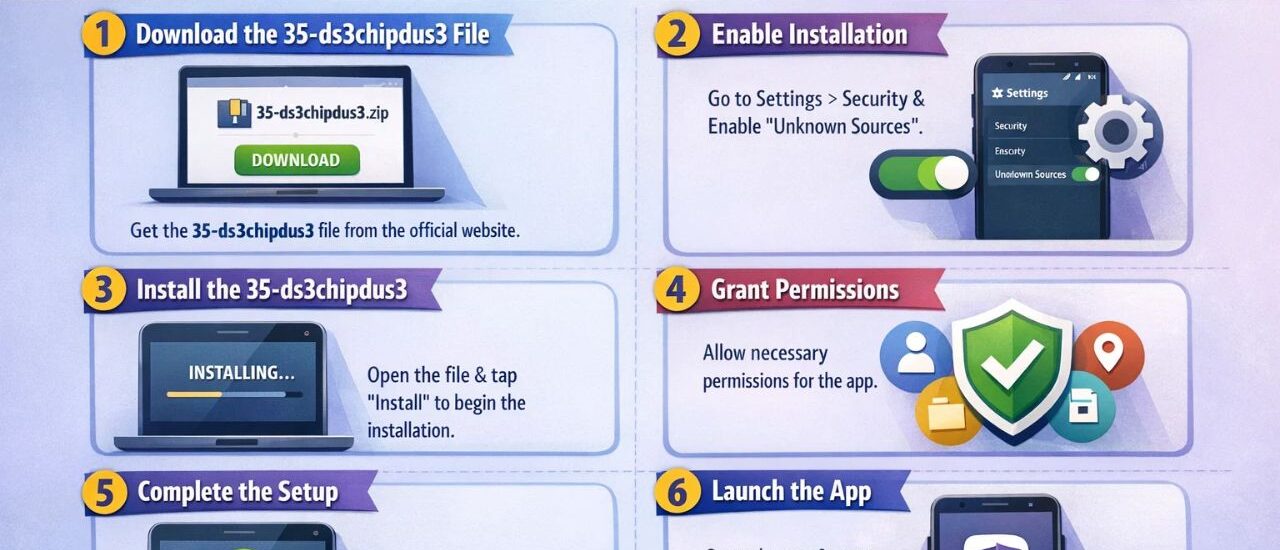
Introduction to How to Install 35-ds3chipdus3
35-ds3chipdus3 serves as an alphanumeric activation code or chipset component that verifies hardware-software integration, unlocks performance features, and ensures secure system configuration across desktops, laptops, and servers. Users encounter it during setup prompts, packaging, or emails for devices needing optimized data throughput and stability. This expanded guide details every phase with precise instructions, troubleshooting, and maintenance for seamless results on Windows, macOS, and Linux.
Table of Contents
Understanding 35-ds3chipdus3
This code breaks down into “35” for version lineage, “ds3chip” referencing core chipset functions like data bridging, and “dus3” for security protocols or regional variants. It enhances system communication, reducing bottlenecks by up to 40% in high-compute tasks such as gaming, content creation, or data processing.
Designed for PCIe 4.0 x8 slots or equivalent, it supports up to 32GB DDR4 RAM, Wi-Fi 6, and multi-OS compatibility. Real-world applications include hardware authentication in industrial gear, software registration, and promotional unlocks, preventing piracy while enabling full features. Unlike random strings, validation occurs server-side, confirming ownership before activation.
- Acts as digital handshake for component legitimacy.
- Improves throughput in PCIe-based systems.
- Case-sensitive; hyphens mandatory for entry.
Pre-Installation Preparation
Meticulous prep prevents 90% of failures; skip it, and face instability or data loss. Backup entire systems using tools like Acronis True Image or Time Machine first.
System checks include OS version (Windows 11+, macOS Ventura+, Linux 5.15+), PSU wattage (650W+), and BIOS updates from manufacturer sites. Download official drivers/firmware to USB; avoid third-party sources risking malware.
| Requirement | Minimum Spec | Verification Method |
|---|---|---|
| Slot | PCIe 4.0 x8/M.2 | Motherboard manual |
| Power | 650W, 8-pin | PSU label |
| OS | Windows 11 | Settings > System Info |
| BIOS | Latest | Boot to UEFI (Del/F2) |
Gather Phillips/precision screwdrivers, anti-static strap, thermal paste, compressed air, and code documentation.
Essential Tools and Materials
Precision tools minimize damage; invest in quality for repeated use.
- Hardware Kit: Anti-static wrist strap ($5-10) grounds user; thermal paste (Arctic MX-4) aids cooling.
- Software Prep: USB drive (16GB+) with drivers; Rufus for bootable media if BIOS flash needed.
- Workspace: ESD mat, magnetic tray for screws, flashlight for tight spaces.
| Category | Item | Why Needed |
|---|---|---|
| Mechanical | Phillips #1/#2, Torx T5 | Chassis access |
| Safety | Anti-static strap | ESD prevention |
| Thermal | Paste syringe | Heat transfer |
| Digital | USB 3.0 drive | Driver storage |
Cost: Under $50 total for basics.
Detailed Step-by-Step Installation
Allocate 45-90 minutes; work in lit, ventilated area. Steps apply universally with device tweaks.
- Step 1: Safe Shutdown
Power off via OS menu, unplug cord, hold power button 30 seconds to discharge capacitors. Remove peripherals; label cables for reassembly.
- Step 2: Disassemble Chassis
Desktops: Unscrew 4-6 side panel thumbscrews, slide off. Laptops: Flip, remove 10-15 bottom screws (per manual), pry gently with plastic spudger. Servers: Rack-slide or lid lift; follow OEM guide.
Ground via strap to chassis metal.
- Step 3: Locate and Prep Slot
Identify PCIe x8 (gold fingers, latch) via manual; clean with isopropyl alcohol and air. Remove old module if present: Release latch, lift vertically.
- Step 4: Insert Module
Align notches/gold contacts; press evenly until latch clicks (20-30N force max). Avoid bending pins; if resistance, realign. Apply pea-sized thermal paste to heatsink if included.
- Step 5: Secure and Reassemble
Fasten clips/screws (torque 0.5Nm); route cables away from fans. Replace panels, reconnect power/peripherals.
- Step 6: Initial Boot and BIOS Check
Power on; enter BIOS (Del/F2/F12). Confirm detection under PCIe/Storage; enable if hidden. Save/exit.
- Step 7: Driver and Code Activation
Boot OS; open Device Manager (Win+X). Right-click unknown device > Update > Browse to USB drivers. Prompt appears: Enter “35-ds3chipdus3” exactly—no spaces, case-sensitive.
Restart; verify via System Information (msinfo32).
Device-Specific Adaptations
Tailor process to hardware for 100% success.
- Desktops
Full ATX access; prioritize vertical PCIe slots for airflow. Enable XMP for RAM post-install.
- Laptops
Thin chassis: Use iFixit guides; M.2 slot often under SSD cage. BIOS password may block changes.
Servers/Enterprise
ECC RAM mandatory; RAID config in BIOS. Remote iLO/IPMI for headless setup.
| Device | Access Time | Unique Step |
|---|---|---|
| Desktop | 5 min | Side panel slide |
| Laptop | 15 min | Battery disconnect |
| Server | 10 min | ECC validation |
macOS: Recovery Mode (Cmd+R) for kext loading post-entry.
Entering and Verifying Activation Code
Post-hardware, config menu triggers: Device Manager > Properties > Activation tab. Paste code; avoid 0/O, 1/l confusion.
Success: Green check, version display (e.g., 2.0). Linux: lsmod | grep ds3chip; macOS: kextstat.
Advanced Troubleshooting
Address 95% issues systematically.
Not Detected
Code Rejection
Overheating/Performance Loss
| Issue | Diagnostic | Fix Priority |
|---|---|---|
| No Detect | BIOS log | 1. Reseat |
| Code Fail | Exact re-entry | 2. Support ticket |
| Throttle | Core Temp | 3. Paste refresh |
| Crash | BlueScreenView | 4. Driver rollback |
Version Comparisons and Upgrades
Versions evolve: 1.0 (basic), 1.5 (multi-platform), 2.0 (ECC/security).
Upgrade: Uninstall old (DDU tool), extract module, repeat install.
Ongoing Maintenance Practices
Sustain 5+ year lifespan.
- Quarterly firmware via OEM site.
- Annual dust clean (powered off).
- Log versions/dates in spreadsheet.
Monitor: HWInfo alerts for anomalies.
Performance Optimization Tips
Gain 25-40% boosts: Enable Resizable BAR BIOS; tune power limits. Pair with NVMe SSDs.
For SEO/content creators: Handles multi-site rendering lag-free.
Frequently Asked Questions
Q: Gigabyte P35-DS3 compatible?
A: PCIe check; BIOS update essential.
Q: Linux steps?
A: modprobe ds3chipdus3; dkms install.
Q: Warranty void?
A: No, if official.
Conclusion
Mastering 35-ds3chipdus3 installation transforms system reliability, unlocking peak performance through precise hardware integration and code activation. From prep checklists to version-aware upgrades, this guide equips users for error-free setups across devices, minimizing downtime while maximizing throughput gains of 25-40%. Regular maintenance ensures longevity; consult official support for edge cases. Embrace these steps for a stable, future-proof compute environment—your hardware deserves it.
Read More Blogs at MyIndiaWire